Showing posts with label cosplay. Show all posts

Saturday, November 5, 2016

Bumper Pokemon! A jigglypuff tutorial!


 In the last post, I explained how to make jigglypuff ears.  This post will explain the rest!  The ultimate goal?  An army of these bumper pokemon!

These bumper balls are about 36" in diameter.  You will probably need around 2 yards of fabric to cover the ball. I bought a pink fleece for jigglypuff, which worked well!

Honestly, I ended up mostly free-handing the fabric application, trying to keep the seams to a minimum.  It resulted in some weirdly placed seams, to be honest, but I managed to keep the front of jigglypuff pretty seam-free.

Once I had the fabric draped, I glued the ears down.  I used hot glue to attach the ears AND the fabric, but BEWARE!  If you let the glue get to hot, it will POP the ball!  Unfortunately, I learned this the hard way.  Below are a series of photos showing the attachment process.


It popped!  Oh no!  We patched it with a UV activated epoxy, initially, but then we ran out and had to get creative.  Ultimately, the patch consisted of some epoxy, regular wood glue, saran wrap, and duct tape.
Ultimately, I would actually suggest cutting your fabric into 2 pieces and trying to center your seams around the arm holes.  In retrospect, that would have been my plan.

Once your fabric is on, you will want to create eyes, which I did with felt squares layered on top of each other.  Like so:


  I used the same technique with Jiggly's mouth, using a black piece of fabric as the base, a darker pink as the mouth, and a small light pink piece inside that.  Once you have the mouth done, it's time to make the hair.  I had an abandoned viking helmet project laying around, and used that as a base.  I then wrapped thin craft foam around each side, and cut the front to look like Jiggly's swirl.  You can see how the base looked below:

You can see the single eva foam strip across the top, which was attached to an eva foam band.
I then attached fabric to it and was left with having to cut out vision holes.  The first attempt was a total failure:

Total horror show

So I connected the two eye holes to make more of a vision bar, and then covered it with pink tulle.  I paired it with some pink clothing, and I was really excited by the end result!  Can't wait to show you all the rest of the bumper brigade!


Monday, October 10, 2016

Jigglypuff: Foam Animal Ear Tutorial


I will admit it: I am a huge pokemon lover.  When pokemon go came out, I was running around Nashville trying to catch em' all, and I even re-watched Indigo League (well, the portion that's on Netflix) so I could have a constant poke-fix.  Re-watching Indigo league reminded me of how much I love Jigglypuff, that sassy little pink blob with his marker of doom. 

I also really love Clefairy, because it is adorable, and for awhile I was thinking it would be really fun to get some moon shoes and bounce around as Clefairy.  So I went on Amazon and looked at moon shoes.  And while I was looking, I found these:

At that moment, I scrapped the Clefairy idea and decided to make Jigglypuff into a reality.

To begin, I decided to make Jiggly's ears.  It was incredibly simple, and all you need is a 2 1/2" thick piece of upholstery foam (approximately 1 1/2' x 2' - it just needs to be big enough to cut 2 10" equilateral triangles.); good scissors; a knife to cut through the foam; black fabric; pink fabric; and hot glue.

Step 1:

Trace two equilateral triangles onto the foam, making each side 10" (you could maybe go down to 9 if you want), and cut out the triangles using your knife.  You should get a piece that looks like this (although I'd already started carving this one):


Step 2:

Carve your triangle into an ear shape!  As you can see above, the outside of the ear should be slightly curved.  You will then want to hollow out the inner ear a bit, like so:

Make sure to leave a lip around the edge of the inside of the ear, as shown above.

Step 3:

Once you have the ear carved the way you want, fire up your glue gun and cut out your black fabric, which will be going on the inside of the ear.  I made sure to cut it slightly bigger than needed, just in case I messed up.  Once you have it cut, glue it down.  Super simple. 

Step 4:

The next step is to glue your pink fabric on.  This is ever so slightly more difficult, as you will have to make a small dart at the tip of the ear to keep the fabric from wrinkling.  You can see how it works here:


The end result?  Some fun Jigglypuff ears that will fit on a huge plastic Jigglypuff body!


Monday, April 11, 2016

Furry Feet!


Hyena feet!
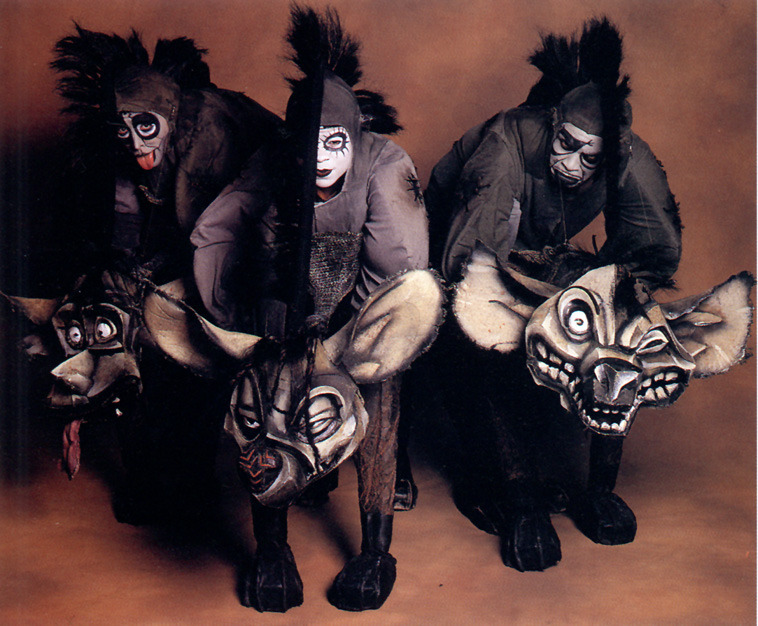
As you may have gathered, here at Cooking and Cosplay, we do more than make delicious things to eat.  We also take costuming very seriously, and have attended Dragon Con in Altanta for the past several years.  This year, we will be attending as the Hyenas from the Lion King.  I will be Shenzi, and Stoney will be Bonzai.

We've modeled our costume concept off of the Broadway hyenas:


So, step 1 for making these babies involved constructing hyena feet for our feet.  For our front legs, we will be doing hand stilts with paws attached (and that will be another post).  Although I will admit that the fur feet are time consuming, they really are not hard to construct.

Step 1:

Get yourself some foam.  We used a block of Premium Poly Foam, 4" x 22"x 22".
Cut the foam down into manageable blocks, and then place your shoe on the foam and draw an outline.  Once your outline is drawn, carve out a hole for the shoe to sit in, like so:


Glue the cut-out piece to the shoe using hot glue.


Step 2:

When you have your shoe glued in the foam, draw your paw shape on top.


Step 3:
Cut the paw shape out, and use scraps to cover the back of the shoe with hot glue.  Once you have everything secured to the shoe, you can work on carving a better paw shape into the foam:


Finished carved foam

Top pair: work in progress on the carve.
Bottom pair: finished


Step 4:

Using whatever fur you decide will work for your feet (we used a short pile black fur), drape the fur over your carved feet, and cut out a square that is about 1-2 inches larger around than your feet.  Next, pin the fur onto the foot form.  Once you have everything pinned, you can start cutting (this may involve unpinning and repinning sections).  Begin by cutting away any fabric that covers the sole of the shoe.  At this point, cut slits between the carved toes, so that you can get the fabric to lay nicely around the toes.  Next, you can start to cut out the darts (a dart is a small triangle of fabric that  helps to make a flat piece of cloth into a moldable form capable of going around all the curves of the form), which will allow the fabric to lay flat on the paws without wrinkles once you have glued it down.


We made the cuts on the center of the main toe and around the sides of the other toes.  This is fairly simple to do: unpin the fabric on the toe and pull it tight to get a triangle of fabric that hangs out or can be folded over.  Next, cut off the triangle of fabric and pin down the remainder.  If it overlaps a little, that's good.  If it doesn't reach and leaves a space open then you can fill it in later with a strip of excess fabric (aka, everything is fixable!).  You will also need to cut a triangle out at the heel, but you should do this after you have already glued down the paw (it makes it easier to pull everything tight, and get everything to line up).

Step 5:

Start glueing your fur down.  You will have to unpin sections as you work on them.  Use a hot glue gun and glue small sections at a time (make sure to pull them tight).  After glueing a section, hold it down firmly until your glue is set, and then continue on down from that section.   Start at the toes.   The way to go about it is to start at the base of the center toe and then work to the tip.  Next, do the same for the surrounding toes.   Once you have all the toes glued down, unpin the rest of the fabric and start glueing the top and sides from front to the back.


Step 6:

Once you get to the opening for your foot, cut out a hole for your foot (an exacto knife helps), making this hole far smaller then your foot so you can then cut slits at the corners, allowing you to cover the inside lip of the shoe.

Next, cut the dart out of the back to remove any wrinkles.  Then just glue down the rest.  Also glue down any fabric that wraps around underneath the shoe on the foam, then cut off any excess that covers the sole of the shoe.

Step 7:

If you find that you have bits of foam showing, fear not!  You can either glue down more fur, or use a sharpie the color of the fur to color in any uncovered bits.


Lion King Hyena Masks


Mufasa! Mufasa! Mufasa! 
The Lion King

For the most part, this mask-making process was one great big experiment. Luckily, it worked out!  Our initial idea involved sculpting the masks out of clay, covering the clay in vaseline, doing plaster of paris over the clay, and then somehow just pulling the dried plaster off while retaining the shape.  Yeah, that didn't work.  After failing miserably at our plaster attempt after sculpting the Banzai mask, we regrouped and started looking into other options.  Ultimately, we settled on Worbla, which comes in sheets and becomes mold-able when heated. 


The biggest concern after we got the worbla was how we were going to heat it and press it into the correct form without melting the clay.  Obviously, the easiest solution to this problem is to get clay that doesn't melt, but we had already sculpted the whole thing out of clay which, as it turned out, did melt.  Based on the fact that we had more problems with applying the worbla to the Shenzi mask, I would say that if for some reason you decide you want a challenge and go for clay that will melt, coating the clay in vaseline first helps tremendously (and this vaseline layer has other uses too, so we recommend using it no matter the clay you use). 


Putting the worbla on the Banzai form

To apply the worbla, you just need a heat gun.  We folded the worbla in half and heated it all up before getting to the application because one side of the sheet had an adhesive, and by "gluing" the two sides together, we ended up with a sturdier end-product.  If you were just putting the worbla onto a foam base (for armor or something like that), you wouldn't need to go through that extra step.  Once the two sides were put together, we just heated it up and molded it onto the clay as best we could.  Application of the worbla ended up being a bit tricky, just due to the weirdly-shaped mask, but other than a few seams and a few misplaced wrinkles, we were really pleased with the end result.

Worbla applied to Banzai form
Once the worbla was molded onto the clay, we used a spray primer to coat the whole thing.  We were hoping that this would help cover up the seams, but as it turned out we needed some additional work to mask those. 
Primered Banzai mask
Once the mask was sprayed with primer and dry, we got to work digging the clay out.  Once again, we learned that a vaseline layer over he clay was helpful here.  The clay came out of the Banzai mask much more easily than it came out of the Shenzi mask.  Once we had the Banzai mask all molded and spray-primered, we got to work on the Shenzi mask.  The process was basically the same, although we had quite a bit more trouble with melting, and ended up basically losing the entire sculpt on the left eye.  To fix it, we ended up with applying worbla on top in the shape we had originally sculpted.  I wasn't 100% thrilled with the result, but it ended up working out and looking fine once all of the paint was applied.

Side view of Shenzi sculpt

Shenzi sculpt


Worbla on Shenzi, Banzai covered in primer
Primer applied to Shenzi
Once we got both of the masks coated in primer and realized that the seams were still pretty visible, we purchased a jar of modeling paste, which let us fill in the seams and then sand the dried paste down to create a smooth form.
To help us cover, up the seams
Seams covered in Liquitex

Seams covered in Liquitex

Sanded Liquitex

Sanded Liquitex

There were, admittedly, still some errant wrinkles on the lips after the molding paste was applied, but we were sufficiently happy (and not sure how fixable they were) and decided to move forward with the paint job.  For painting, we used createx airbrush paints, and mixed together black and white to create our desired shade of gray.  We settled on the createx because it also works on fabric, and we wanted to be able to color-match our body-suits to our masks.  We opted to go a hair lighter than the hyenas were in the movie, just because we figured the features and other paint would stand out more in person if we weren't a super dark gray. 

Airbrushing Banzai
Masks drying after getting their first coat of gray
Faces being painted
Once we got the masks painted, we added on the final touches of teeth and hair.  For the teeth, we just used foam strips, which we hot glued into the mouths and then carved to look like teeth.  Once the carving was done, we added white paint to the foam to make the teeth pop.  For the hair, we used roving wool, which I simply rolled and then hot glued to the masks.  For Shenzi, we just needed the forelock.  Banzai needed a tuft on top of the head and some bushy eyebrows.

Finished Shenzi Mask!

Banzai nearly finished, just needs his eyebrows in this one

Add caption
Finished Banzai mask!